Digital Disruptive Relationships

Being at 7th Grade camp last week afforded me the opportunity to catch up on some professional learning via my network. This video , "Where Disruption Will Take Us", grabbed my attention for many reasons, but mostly because I'm a sucker for all things "disruptive." Whether that's disruptive innovation, disruptive practices in education or business, or even disruptions in traditional faith development models.

James McQuivey, VP at Forrester, talks about how traditional models of disruption, (ala Clayton Christensen), are themselves being disrupted using the already existing technology platforms. This time, the disruptions aren't the digital platforms themselves, but rather the consumer relationships in, with, and under those platforms. The initial digital disruptions of the last century have not only caused us to re-think how goods and services are delivered, but how those digital platforms challenge consumer relationships with those companies that provide those goods and services.

This notion of business disruption got me thinking about disruptions in our world of education. While technology has certainly shaken up the field of personal learning, the technology itself is only the platform by which education will be changed in the future. For the first time, at least in my understanding of teaching history, the technology now affords teachers the opportunity to focus on what they really do well, primarily, foster learning relationships with students, not just deliver content. When teachers take hold of this relational model of student learning, it is then that truly innovative learning disruptions occur.

If the driving focus of every school is truly learning, and we allow that to become our mission, or non-negotiable, then everything else is can be tailored precisely to meet that outcome. Traditional understandings about assessment, school day schedule, or even content delivery platforms are open for discussion/disruption. I definitely do not think that would be a bad thing, as long as at the heart of these disruptions is student learning.

Would these innovations in learning ruin traditional models of "school?" You bet, but the cultural, digital disruptions have already done that (Well, in part, there are still some schools and teachers who have refused to recognize that we are already 15 years into a new century)! It's only when teachers embrace the technology disruptions that the other innovative learning disruptions make sense. Teachers now have the ability to focus solely on developing learning relationships with students and return that relationship to the heart of what we understanding school to truly be.

By the way...I'm still trying to figure out what that looks like for me and my ministry! How about you?


Image: by Flickr User: Brian Solls, "Disruption as an Ecosystem(CC BY 2.0)

Conditional Statements

I came to the conclusion some years ago that I wasn't really teaching computer science. I thought I was
teaching computer science, but it was really just computer applications. My students were learning how to be
power users and consumers, but not programmers and creators.

Thanks to a summer workshop from the CS Department at Washington University in St. Louis, these days I've become more intentional about being a true computer science teacher. My Math Application Fridays activities have started engaging students in more open ended projects which force them to work through solutions to problems. Using tools like Scratch from MIT, students are subtly learning about the logic behind programming instructions. Even our 1st grade teachers are getting into the CS mode, by having students work through Kodable on the iPad.

One particularly important programming concept I introduce to students is the conditional statement. Now for the most part, students get the idea of how if/then statements work. For those who struggle, I've had success connecting cause and effect to if/then logic statements and they tend to eventually "get it." Conditional statements are an important logic concept regardless of the syntax you are programming in.

Conditional statements are also a great conversation starter with students about the faithfulness of God! While if/then statements drive the logic of just about every program, it does not drive the logic of God's love for us in Christ Jesus!

How often do our students feel like they area loved or valued based on their behavior or some other metric? Unfortunately, I fear there have been times I've left students wondering IF they are truly loved based on their classroom behavior or their ability to successfully complete a task. I have also had students who seem to set their entire identity on a grade book percentage. Don't get me wrong, it is awesome to see students set goals which can be measure by a letter grade, but it's not healthy for them to tie their self efficacy to their success or failure. God's love for us in Christ is NOT conditional. There is no eternal if/then statement when it comes to earning salvation; there are no "ifs"... just a "because." Because Jesus lived a life I could not live, and because he died as a sacrifice in my place, I am forgiven, redeemed and set free from the guilt and shame of my sin. My eternity is secure and my today is renewed because of the unconditional love and sacrifice of Jesus.

Being able to remind students that about who they are in Christ is a powerful thing. Knowing that God doesn't tie their failure to an eternal destiny is crucial to helping students attain a strong faith foundation. That is one way of looking at it, but there is also another conversation to be had!

It is also important to remind students that God does indeed care about the choices they make now. God has given us tools like the Ten Commandments as a way for us to find peace together and provide a guide for living in community, both with Him, and our neighbors. If we want to get along with our neighbor, then we should protect his reputation, marriage, property, life, etc.

The reality is that many of our life choices on earth do follow the if/then model. but those choices need to be grounded in the unconditional truth of God's love for us in Jesus. Loving your neighbor and serving your community make complete sense once you understand how much Jesus loves and serves you!

Who would have thought that something as simple as a conditional programming statement could provide such deep conversation with our students! They not only build Computer Science fluency, but the serve to strengthen and grow students along their faith journey?


Dot Connecting

Some of the best teachers I know are "Dot Connectors."


Teachers who are dot connectors are good at...

  1. Being learners themselves, even when the topic or idea doesn't immediately show its usefulness.
    We have monthly professional development meetings (AKA "faculty meetings") and at our last gathering I introduced the concept that computer science is not just a class or subject specific discipline that needs its own curriculum and teacher in the elementary and middle school (I know some would disagree with this, but you've got to start somewhere, right?). Rather, by using online tools like Scratch, or apps like Scratch Jr., Tynker, Hopscotch, or Kodables, teachers could introduce fundamental logic concepts with out having to implement a full blown CS curriculum, or work without having to teach coding.

    Inevitably there were teachers who felt it was a waste of time, because "this doesn't pertain to me," or "I'm not a computer teacher." There were however those teachers who took time to do the difficult intellectual work of recognizing the importance of introducing these simple logic concepts and then went a step further to identify WHERE in their current curriculum these ideas fit the best. They connected the dots!

    It is these teachers, these "dot connecting" teachers, who are willing to engage ideas about new learning outcomes, even if they don't understand the full impact on their classroom practice yet. They are willing to to give the time and mental energy for the future learning of their students.
  2. Seeing learning opportunities as a way to grow there practice.

    Dot connecting teachers recognize that their practice is shaped by the world around them, and not just the discipline that they teach. These are teachers who will be able to say that they've been teaching for 25 years, but didn't teach the same lesson 25 times.

    Using the faculty meeting example above, I started our faculty introduction to computer science by reading from Douglas Rushkoff's book Program or Be Programmed. In it he challenges the reader by saying,

    “Programming is the sweet spot, the high leverage point in a digital society. If we don’t learn to program, we risk being programmed ourselves.”

    The world is a much different place today than it was even ten years ago, and as the world changes, so do some of the needs of our students. A dot connecting teacher recognizes the changing world and adjusts their practice to meet the needs of their students. Teaching is job similar to paddling a canoe up stream, if you're not paddling, your going backwards.
I'm not sure that teachers are intuitively dot connectors on their own.  Is dot connecting a skill? Is it a personal characteristic or creativity trait? I tend to lean more toward it being a disposition.

After experiencing my third #edcampSTL this past weekend, I find it hard to believe that not all teachers are "dot connectors."

I'm NOT saying "non-dot connecting" teachers are bad teachers. There are a plethora of caring, loving, and awesome teachers who just happen to need stuff laid out for them in detail before they will engage new ideas, new methods, or new technologies. No, I'm not saying they are bad teachers, but there is just so much more they could teach their students besides core curricular area, if they didn't want the immediate gratification of professional development.

I praise God for the dot connecting teachers! I want to BE dot connecting teacher and I admit that I am not always a dot connector.  Tomorrow will begin my eighth or ninth Midwest Educational Technology Conference. There have been times when I haven't wanted to go, because I wasn't "getting anything out of" the sessions. I was always looking for the latest and greatest new web tool, or website, or resource and when I wasn't getting it, I started to blame other people. The reality is that I only have myself to blame. So this year, I'm showing up with a renewed attitude to connect more dots! I'm going to be doing a lot more thinking about my students and the potential impact new learning spaces, places, and tools, will have on their future. God willing, I'll even share my learning along the way...likely with the readers of his blog....but for sure with my students!


Almost ready for the New Year...

If you are a reader of this blog...which is quite a funny statement within itself, because there hasn't been much to read this past year...then you know how much I've struggled with making the time to write. One of my reasons/excuses is my perceived lack of writing ability (there are consistently warrants out for my arrest from the "grammar police"). The other is my own selfishness with regards to wanting to write something engaging, relevant, or new. Frankly, these days, I have not been learning a whole lot of anything new to share. With the addition my role as an LMS admin, school accreditation, and now teaching 5th grade mathematics, there has not been as much professional development and implementation time as I'd like. Thinking about learning has been relegated to passing conversations with colleagues and even more infrequent tweets. Besides, how many more articles need to be written about the SAMR model or blended learning?

But then again, maybe writing about my "non-new" experiences and sharing some of my own personal struggles and successes through learning processes is exactly what someone else might actually like to read?

As much as I'd like to have "grammatically squeaky clean" articles, maybe this blog needs to be more about process? Could I live with being a writing "hack."  I do have close to 24 blogs that have yet to see the light of day because they need editing. Maybe now is the time to just say the heck with it and post them? Maybe they would spark a conversation waiting to be had? Isn't that really what reflecting and blogging is about anyway? If not having a conversation with an audience, then at least taking the time to think through ideas with myself?
Flickr Image by Emilio Quintana (CC BY-NC-SA)

I'm not "resolving" to do anything! I'm not a fan of the whole New Year's resolution thing, but I am committing to be more thoughtful practitioner this new year with regards to the sharing of my teaching practice.

Some of my posts may be short, but at least I have set my sights to sharing! Isn't that what good teachers do anyway?

God's richest blessings to you and your student's in the coming year. Bring on 2015 and all the experiences that it will bring!


Student Strategies for Web-Based Researching

In an effort to be more practical, here is a list of strategies our 7th grade students created for what do if you don't understand something that you're reading on the web (some prodding was used to create these):


  1. Open a new tab in your web browser and dedicate it for "extra research." Students underscored the importance of using the "define:" operator as an important tool. This might sound trivial, but the fact that students admitted that they have to keep searching as opposed to lazily doing a single search, was worthy of putting on the list! Searching is NOT a "lazy man's" activity.
  2. Especially in Google Chrome, single right click on words and click the "Search Google for..." option. This was a shortcut to the above mentioned "New Tab" option.
  3. There was some good discussion with one class about how and when to follow hyperlinks. Good web authors will add hyperlinks as a way of providing extra or needed contextual information for their readers. We never did come to a general consensus on exactly WHEN is the best time to follow links (follow links in the context of the reading or wait till the end of the paragraph or article), but it was good to get them thinking about hypertext reading.
  4. As was mentioned above, students did identify the use of search operators (Google Advanced Search options), but few use them because they felt that they weren't effective. It seems that Google has been working hard to refine their search algorithms and page rank formulas to account for "question asking." While this isn't always the case, students felt that the advanced search features didn't get them any closer to what they needed than well thought out key words.
Context is everything for young researchers. Finding information about topics you already have prior knowledge of is relatively straight forward, but what do students do when they have no context? It is important for students to have identifiable strategies in their "tool box" when learning without a mentor in the room.

Any other strategies that we most certainly missed?

One other quick note, we did identify ways to cut down on moving adverts and clean up articles for reading by using the "print" feature of most news sites. However, most news sites are getting saavy to this trick, and have started adding advertisements to their print previews (those sneaky guys)! BUT if you go one step further on some sites and actually print the article to PDF, that did away all together with the ads.

image by Flickr user Jeffery Beall (CC BY-SA 2.0)

Content Filtering and Jesus

So, why at my school do we pay to have a web service filter our student email?

Do we want to identify and stop digital bullying? Yes.

Do we want to stop kids from sharing content they are really too young to be sharing? Yes.

Could it be we want to provide a safe environment where kids can learn from their mistakes with minimal consequences to their digital footprint? Yep.

While all of the above points are important, we filter student email for one major reason, so we can talk to kids about Jesus!

We just had a student send a very simple email to another student, which got flagged and blocked (two small, hurtful words, "you suck"). Knowing that the email didn't make it to its intended audience was a huge relief, but more important, was the opportunity it provided for us to talk about the motives of the sender and the struggle that child has with their personal filter. It gave us the opportunity to share the love and forgiveness of  our Savior. That child needed to hear that the God who loves the intended email recipient is the same God who loves and forgives them. It's only when kids start seeing each other the way Jesus sees them that we will begin to know what true "digital citizenship" looks like. That blocked email gave us the opportunity to have a conversation, not so much about good email etiquette, but rather their heart.

So, was money worth it? I'd have to say, yes!

If you're interested in knowing what service we use, feel free to contact me directly. I try not to advertise too much on this blog :-) 


Image: "THIS DOOR BLOCKED" by Flickr User: pheezy was used under an Attribution, Creative Commons License

Finishing Strong

For those of you who are members of the Technology in Lutheran Schools Ning social network, you received this in an email yesterday. For those of you who are not members, I decided to post it here as a source of encouragement as you finish out these last weeks of the 2012/2013 school year.

How "strong" are you finishing out this school year?

The video below was recently shared by one of my teaching colleagues at morning devotions and highlights the impact of "finishing strong," even when it seems too difficult.

Maybe you are feeling a little beaten up as the school year draws to an end? Maybe this has been an especially difficult year?
Maybe it's been difficult to be the best teacher you can be?

Don't give up! Get back up and finish strong!

Take to heart God's words to Joshua:

"Have I not commanded you? Be strong and courageous. Do not be afraid; do not be discouraged, for the Lord your God will be with you wherever you go.” Joshua 1:9 (NIV)

Not only does God call us to be strong, but He even provides the means by which we can BE strong (He will be with you)! The trumpets of Easter may have faded amidst the planning of spring field trips, looming end of the year report cards, and student portfolio grading, but the victory of Christ over sin and death is enough to strengthen you into and through the final days of this school year!

  So, how are you finishing the school year?

What is YOUR role?

Thanks so much to +David Black for posting "Who Are Your Tech Gurus?"  It is a true blessing to be part of Dave's professional learning network. He is for sure a significant contributor to my professional walk and is part of what I like to call my IronMen Club (Proverbs 27:17). I am a better educator because of his work and the work of many other like-minded educators. Thank you!

His post got me thinking about a statement I once heard regarding the Christian life journey:
"Everyone should have a Paul, a Barnabas, and a Timothy!"
Everyone should have a Paul!
Looking at the Epistles of the New Testament, there is little doubt that the Apostle Paul was an effective teacher and leader to the fledgling churches of the first century. With an eye, ear, and tongue struck with wisdom, he mentored young leaders, gave wise advice, and by the power of the Holy Spirit spoke truth into the lives of God's people. Everyone needs a Paul!

Which personal relationships in your life consistently point you to the cross and teach you? Who is the "Paul" in your spiritual walk?

Everyone needs a Barnabas!
In the book of Acts, Barnabas was one of the first people to "have Paul's back" after Jesus claimed him for service to the Gospel (Acts 9:27). Barnabas and Paul traveled together, taught together, and shared the ups and downs of ministry together, but they also had disagreements. I can imagine how these two friends held each other accountable at every turn. Even after going their separate ways following a contentious disagreement, Paul, in later Epistles, counts Barnabas as a friend and encourages others to recall the grace that was taught them by BOTH he and Barnabas. Everyone needs a friend with whom they can not only share joys, but that can also "tell ya' like it is."

Who walks with you on a daily basis? Who is the one willing to call you out when you need correcting? Who is your Barnabas?

Everyone needs a Timothy!
Timothy was a young pastor charged with leading the people at Ephesus--not such an easy task. Paul didn't just kick Timothy into the arena and say, "Good Luck with that." On the contrary, Paul mentored him through targeted correspondence, encouraging him, exhorting him, and most importantly praying for him! Timothy, being a young man, I'm sure struggled with with his leadership responsibilities, but Paul reminded him time and time again to be faithful in showing God's grace to His people. Keep the main thing, the main thing. I'm sure Timothy needed that! I'm sure someone needs that from YOU too!

Who in your life can you stand next to and encourage, instruct, and lift up in prayer? Who in your life needs a mentor?

Now nothing in life is rarely this cut and dry. I don't know that I could single out ONE person for each of these roles in my life. More often than not, the person who is my Paul winds up also being my Barnabas. The ones who I've spent time mentoring, winds up teaching me an awful lot in the process as well!

It is just neat to see that God has wired us for relationships and relationships of ALL kinds.

These relationships don't just apply to our faith journey alone, they apply to our professional journey as well.
Who in your professional life would you count as your Paul, your Barnabas, or your Timothy. Who can you turn to with unanswered questions? Who do you trust to lead you to good and wise answers? Who in your professional circles can you share the ups and downs of classroom life with and from whom can you get honest feedback? And who have you taken the time to mentor?

There are literally dozens of opportunities each day to engage in one of these significant roles.
As +Bernard Bull  pointed out in his comment to Dave's post, you can play a significant role in someone's professional growth even if it's just being part of the Twitter "collective brain."

As a teacher, you ARE important! Not just in the life of your students, but in the life of your colleagues as well. If the 21st century has taught us anything so far, it's that you can be someone to someone else whether near or far. Take the risk! Be who God has called you to be! Engage the community. Dave and I are better for it....and so will you!

Image: "Community-Manager" by Flicker User: kikembo
Used under a Creative Commons Attribution License

Google Earth Test Video / METC Take-away

After being at METC last week, one of our teachers wanted to give creating flip classroom videos a try. She already has a class blog and is wondering if that is the best place to put the videos.  This post is a test for uploading videos directly to Blogger as a possible solution for posting videos.

I know that uploading directly to her blog is probably NOT the best option, but at this point in the game, we just want to get it up and in a location where it can be seen by students. This is like my scaffold for this staff member! One thing at a time...

The video I'm uploading here was a screencast designed for my sixth grade technology class to answer questions about presenting from Google Earth. I referenced this video as a remediation step for anyone needing an extra reminder about how to save placemarks and execute their "tours."


While I'm waiting for the video to process here in the edit window I thought I'd share a couple of take-aways from METC this year.

1. Global connections for students are important. It's not just a matter of learning ABOUT other cultures and people, but it's actually getting to know them, talk to them, and learn with them that makes a difference.

2. Technology use in the classroom affords us the opportunity to make learning student centered. The devices in your kid's hands free them to identify problems, solve them, and then share that learning with others.

Those are my two biggies. Hopefully I'll carve out some time to share more!

#EdCampSTL--My First Unconference

People who know me understand that I tend to over-state matters just a bit. One of my potential over-statements is the idea that the "unconference" is a revolution in teacher professional development. Now the reason I say potential over-statement is because I haven't ACTUALLY attended one!

From what I understand, attending an unconference is an evolutionary learning experience. The connections and relationships formed at these types of events generate learning sparks which open a whole new world of professional learning for some teachers. I'm hoping that will happen again on Saturday!

Tomorrow is my first EdCampSTL. I have seen EdCamp events all over the United States for over a year or so now, but this is the first time I've seen it in St. Louis.

What I'm most anxious to see is how the day is organized and run. Even before attending an event like this, I've considered throwing together a Lutheran unconference with my friend Mike Kratzer for St. Louis area Lutheran Schools. Beside the no/low cost aspect, we know there are ton of talented teachers in the greater St. Louis area who would be great at sharing their ideas. Many teachers want no part of  presenting a traditional conference sectional, but would be willing to be part of the unconference discussion/sharing model.

So, tomorrow's the day.  I am bummed to be missing the social get together tonight, but I'll be ready of a day packed full of conversation and learning.

Even if you're not attending be sure to check out the information coming from the #edcamptl hashtag and Google Plus Community

Who knows...you might even hear about a Lutheran Schools Unconference coming soon to the St. Louis area!


Why I Want My Students' To Work Online

Something interesting happens when a student does a Google search for something and either their own work or the work of a classmate shows up. Today was the first day that actually happened!

A little background first: As a concluding project to studying the "Progressive Era" in American History, our 8th graders have to give a class presentation about a National Park of their choice. This is a "role playing" project which has them take on the persona of a park ranger who must give a presentation to a congressional over-site committee. The goal of the presentation is to convince committee members to not de-fund or close their park. Here's a link to the project site if your interested. As an aside, I like this project, in part, because a component of the rubric has them contacting an actual NP Ranger. Most students just want to email, but a majority wind up having to make a phone call and talk to a live Ranger. We've got to work on our people skills along side the digital ones!

In the process of doing research on their national parks, I was teaching them how to use the filetype: operator in Google to search for KMZ files when low and behold the top entry for a Shenandoah National Park search was from our school wiki page.


The lesson my wide-eyed students took away from this was that their work, which gets posted online, is important. It's not important because they are getting a grade, or because it's for a presentation they will have to give in front of an actual audience, but rather because their work is digitally permanent.

It was neat to see their reactions when I told them that file was uploaded back in 2008...an eternity ago for a middle schooler! If the work which a student did almost four years ago is coming up in the search results now, what might happen to the work they post today?

The answer to that question has all sorts of implications, many of which I won't get into here, but the most obvious one is of quality. All of the sudden knowing that someone from the future will use their work all of the sudden ups the ante on their effort.

Never discount the power of audience, either now...or in future!


If you're interested, here is a list of helpful search links and/or sites:

  • Google Search Operators--http://www.googleguide.com/advanced_operators.html
  • My Diigo sites about Search--
    http://www.diigo.com/user/rjacklin/search
  • Power Searching with Google--
    http://www.google.com/insidesearch/landing/powersearching.html


Unexpected Urgency

Over the past two or three years, I've felt a sense of urgency to be creating more computer science related learning activities for students.

There are many likely catalysts for moving in this direction, none of which is my experience with computer science. After all, I was not a computer science major in my education program, I didn't / don't particularly enjoy math and I'm not particularly good at logical, critical thinking puzzles. I used to think I was a good logical problem-solver until I was asked to help troubleshoot the class schedules of our entire middle school schedule and I felt my brain locked up; my thinker just does not feel at home in certain areas.

By nature I'm an end user. If you asked me to figure out how to use something, I can generally do it. Please don't ask me to program it or create a flow chart around the logic of it's design.

So here I am with this glowing feeling of inadequacy about my lack of skill in the process of programming, while at the same time I know I should be teaching my students to THINK like computer scientists!

Then it dawned me...the power of teaching in this digital age of learning isn't that you always have to be the knowledge expert, but rather you need to be be able to help students curate their own learning. While that sounds awkward, it makes quite a bit of sense. I've seen this most to be the case in the electives I have chosen to "teach." The emphasis has shifted away from what content related area do I know that most about, to which subject/class idea has the most resources available to help me facilitate and mentor students! If I stumble as a teacher, it's not that I don't know how to do something, but that I wasn't able to connect my students with the people/resources they need to help them learn.

Now I am NOT saying that teachers should not be knowledge experts. For example, I "taught" a computer science elective this past semester which focused mainly on using the program Scratch. I know how to use Scratch, and I know how to help students storyboard and plan their ideas, I just wasn't quick at the troubleshooting process. My helping students learn to debug involved asking a LOT of questions and relying on other students (near and far) to provide insight:
"Is there a YouTube video about how to do that?"
"What other script could you have used to get the same result?"
"What would happen if you tried the other script instead?"
"Did you find any Scratch discussion forums addressing this same issue?" 
I didn't particularly know the answers to those questions, but nine times out of ten my students where able to learn the correct answer. 

The one thing I do know, however, is it is important for kids to know how to think like computer scientists. Regardless of my adequacy in that area.

Douglas Rushkoff in his book, "Program or Be Programmed" says:
Digit technology is programmed. This makes it biased toward those with the capacity to write the code. In a digital age, we must learn how to make the software, or risk becoming the software. It is not too difficult or too late to learn the code behind the things we use--or at least to understand that there is code behind their interfaces. Otherwise, we are at the mercy of those who do the programming, the people paying them, or even the technology itself. (p128)

So, comfortable or not, it's time to start pushing a little bit more into the areas of programming (slowly learning javascript at CodeAcademy). Maybe not so much the language itself, but the skill sets that accompany them.

Now to be sure, the "discipline" of computer science is much broader and deeper than learning a programming language, but it's not a bad place to start. It is my goal that within the next three or so years, to start encouraging my faculty to integrate the Computer Science Teachers Association (CSTA) K-12 Computer Science Standards (membership to CSTA is free by the way).

I definitely don't have this all figured out, but you've got to start somewhere, right?


image "Binary" by Flickr user: noegrandado
Used under an Attribution, Non-Commercial, Share-Alike Creative Commons License.

Faith and Technology, Practically Speaking–Honoring One Another’s Work


Below is a re-posting of an article I had written for the MTM Project Blog on the 14th of this month: <http://www.mtmproject.org/archives/210>. 
One of the most hotly discussed areas amongst teachers and parents today is how we help students use technology in a safe and responsible way. As Christian teachers and parents, we take that question a step further and ask how do we help student learn to use technology in a God-pleasing way?
While there are many approaches to answering these types questions, I suggest we take a catechetical approach. Since the Ten Commandments were given by God to help his people live together in community, the commandments are a great place to start thinking about how we help children learn to be God’s kids online! So, let’s start with something very practical: stealing.
With the invention of digital technologies, the processes of copying & pasting, ripping & burning, and creating & remixing have become easier and easier. What once used to be the domain of professional musicians, photographers, and writers is now accessible to everyone with a computer. How do we teach students that when a person creates something of value, that creation should be valued, respected, and protected?  How do we help students see that just because something can be downloaded, does not mean that it should be?  How do we help students see that the property talked about in the meaning to the 7th Commandment applies just as much to intellectual property as it does to physical property?
The 7th Commandment and its meaning, according to Luther’s Small Catechism, not only exhort us to not steal our neighbor’s property (physical and intellectual), but it also calls us to help him “improve and protect” it. As teachers of the Gospel, we can have a powerful impact as we model and instruct students on the appropriate and respectful use of intellectual property.
Modeling Appropriate Use
One of the ways we can help students “improve and protect” their neighbor’s creative work is by intentionally modeling respect for a content creator’s work in our own practice. Educators at every level should be citing the sources, images, and media they use with students. The old adage is always true: students’ learning is caughtmore than it is taught. When students see you as their teachers taking time to properly cite sources, they will be less likely to hassle you when it comes time to have them provide documentation for their work.
Honor the intellectual property of others by properly citing work.                                                                           
This is especially true if you want to use a copyrighted work. Teachers need to make a solid effort to get permission to use content labeled as All Rights Reserved. I will often use images for presentations from the image sharing website Flickr; and more often than not, the image(s) I want to use are labeled as All Rights Reserved. Without exception, every photo owner I have contacted has given me permission to use their photos. When I get the email confirming permission to use, it’s rewarding to let my students know we are 100% legal. While having to go through that process of getting permission is a bummer, it is a worthwhile endeavor.  Besides, in my experience, copyright owners are more than willing to share and grant you permission to use their stuff as long as you ask! You cannot be guaranteed that a copyright owner will always give permission; but it is their right to make that decision, not yours.
Since the 1998 Digital Millennium Copyright Act, even if materials are not registered with the copyright office, copyright laws still protect them and they should not be considered in the public domain unless specifically stated.
As educators, we have freedom to use a wide range of copyrighted material for classroom instruction on a single occasion, even if prior approval has not been granted, as long as four conditions are met:
  1. The clear purpose of use is for teaching, scholarship, or research.
  2. The nature of the material must permit copying.
  3. The amount used of the total material is limited (10% or less).
  4. The use of the material cannot have a negative effect on the present or future sales or market value of the work.
The problem we run into though is that our students are not able to make the same distinctions about Fair Use as educators. I have never thought about the 7th Commandment as having any gray area, but trying to interpret it in light of Fair use guidelines makes it unclear at best and, at worst, a legal nightmare. There has got to be a better way.
Teaching A Better Way
Digital technology has forced the hand of many artists. Very few content creators want their work in the public domain (free for anyone to use and for any purpose), but the restrictive nature of copyright to many is equally undesirable. There has to be some middle ground, and thankfully there is: Creative Commons (CC) Licensing<http://www.creativecommons.org>. In a nutshell, Creative Commons is a less restrictive, “Some Rights Reserved” licensing structure for content creators who would like to retain exclusive ownership rights to their work, but feel comfortable giving away some of those rights.
Creative Commons licensed works are identified by four characteristics or licenses <http://creativecommons.org/licenses/>:
  1. Attribution–”This license lets others distribute, remix, tweak, and build upon your work, even commercially, as long as they credit you for the original creation.” Every CC licensed work carries an attribution license. People who use a CC licensed work must give credit or attribute that work and do it in a way identified by the content creator.
  2. Non-Commercial–Works may be used in any manner as the user sees fit, but they cannot make a profit off of the use of the licensed work. The premise is that the only person who should be able to make a profit from their work is the creator. Non-Commercial licensed works are free to be distributed, remixed, tweaked, or built-up, but they cannot be used for commercial gain.
  3. Share Alike–All works created under this license can be remixed, tweaked, or built upon; but the new work must have the have same license as the original. So, if you find an image on Flickr that is licensed as share alike, you are free to edit or change it in any way you would like; but when you are done, the new image must have the same license as the original image you started with it.
  4. No Derivative works–Any Creative Commons work identified with a non-derivation symbol must be used “as is.” The content can be distributed, just as long as it is used or passed along unchanged and whole.
The great thing about these licenses is that they can mixed and matched to give content creators maximum flexibility. For example, all of my personal online content is licensed as Creative Commons: Attribution, Non-commercial, and Share alike. This means that anyone who wants to use, remix, tweak, re-purpose or copy any of my work is free to do so as long as they attribute me as the original creator, they do not receive monetary gain from its use, and they must also license their work as “share alike.”
Creative Commons works can be found all over the web. Websites like Google images and Flickr give teachers and students the ability to narrow down keyword searches to only include results which are labeled for reuse or are Creative Commons licensed. There are also websites like CCMixter and digCCMixter that have whole songs, loops, sound effects labeled for reuse. YouTube now allows users to label their uploaded videos as Creative Commons as well.
Teaching students to search and find this type of licensing takes the ambiguity out of using someone else’s work! Our kids can create with confidence, knowing that they are not only upholding international copyright law, but that they are also showing honor and respect for other people’s work.
Looking for more information about Creative Commons licensing or copyright in general? Check out the following links:

image:"Stealing on flickr continues.....", by user: Nisha A' was used under a Creative Commons Attribution license
I have a substantial number of blog articles that were drafted, but never finished. In an attempt to honor the ideas presented in them, I'm going back and at least getting them ready to publish. Some are more practical than others, but they should at least see the light of day.

A colleague shared this poem/prayer during faculty devotions last week that I thought I'd share with you.  It highlights a fundamental truth about children and how much school, even though it tries, denies them the freedom to be who they truly are.

Jesus and the Children
Oh, Lord Jesus,
Some days I wonder what you saw in them.
How could you gather those whiny, crabby little humans in your arms and bless them?
Did they push and shove to get ot you,
or worse yet,
take cuts in line?
Did they tattle on their best friend
or ruthlessly tease the victim of the week?
That's the reality of kids, Lord.
Oh, but help me to remember
that no less real
is their curiosity, their open-heartedness, their zest.
Nowhere but in children
do we see such receptive, eager and humble learners.
So, Lord Jesus,
remind me what you saw in them:
the very kingdom of heaven.
Murphy, Elspeth. Chalkdust-Prayer Meditations for Teachers. Grand Rapids, MI: Baker Book House, 1970. 24. Print.


I absolutely love the section about God creating students with "curiosity," "open-heartedness," and "zest." I truly wonder sometimes how much of the way we "do school" actually takes those traits into consideration. When as a teacher, I sit down and design a learning experience for my students, do I see them as "receptive, eager, and humble learners"? Do I acknowledge their ability to l when I create an environment for them to learn?

Those are very powerful descriptions of our student learners. How willing are we to take advantage of that and capture that with our students?


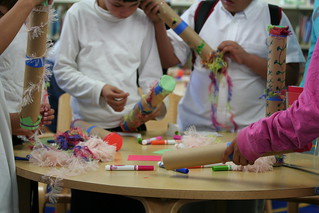
Image: "Children learn how to make Chilean Rain Sticks at East Palo Alto Library" by Flickr user: San Mateo County Library
Used under a Creative Commons Attribution-NonCommercial-ShareAlike 2.0 Generic

METC12 -"A Funny Thing Happened on the Way to the Future"~Adam Bellow

METC 2012-Dr. David Thornburg--"

Below are my notes from the first keynote by Dr. David Thornburg--"Can You Hear Me Now: The Powerful Rise of Mobile Learning."


So is it over yet?

Now that all the boycotts are done and elected officials have taken their names off of sponsorship lists, does that mean that all the hubbub about SOPA and PIPA is done? I think this video presentation by Clay Shirky, from a recent TED event, answers that question.

Full disclosure: I really enjoy listening to Clay. I've read both of this books "Here Comes Everybody," and "Cognitive Surplus" and have admittedly "drank the Kool-Aid" if you will. If anyone disagrees with his assessment of the situation, I'm open to hearing your opinion, but I think he does a splendid job of explaining the major issues with the legislation and the back-story that goes along with them.

All the more reason to involved with teaching our kids about joys of creating and using Creative Commons licensed content!


Cultural Shifts in a Fast Changing World

Below is the text of an opinion paper I wrote for class regarding cultural change in a digital age. I thought is was relevant to post here because I share some thoughts regarding Missouri Senate Bill 54, now the Amy Hestir Student Protection Act of 2011.

If I tried to enumerate all of the ways that digital technology is, has, and will affect culture, we would surely be here many days. But to underscore my thoughts on the matter, all I need to do is point you toward section 162.069 of Missouri Senate Bill 54. It reads as follows [emphasis mine]:

SECTION 162.069 - By January 1, 2012, every school district must develop a written policy concerning teacher-student communication and employee-student communications. Each policy must include appropriate oral and nonverbal personal communication, which may be combined with sexual harassment policies, and appropriate use of electronic media as described in the act, including social networking sites. Teachers cannot establish, maintain, or use a work-related website unless it is available to school administrators and the child's legal custodian, physical custodian, or legal guardian. Teachers also cannot have a nonwork-related website that allows exclusive access with a current or former student. Former student is defined as any person who was at one time a student at the school at which the teacher is employed and who is eighteen years of age or less and who has not graduated. --(Amy Hestir Student Protection Act of 2011)

What you see in this now Missouri law is a visceral reaction to an alarming trend of sexual abuse by teachers of students. But what you also see is a fundamental misunderstanding of the shifting nature of how teachers and students communicate and relate to one another in the digital age. I believe society at-large does not understand how new technologies have transformed the teaching and learning relationships between students and their instructors (or at least provides a solid platform for facilitating change). Learning relationships have shifted from being based solely in a place (a school building), to a more holistic anytime, anywhere relationship focused on learning and is facilitated by new communication tools.

While teachers used to only be available between the hours of 8:00am to 3:00pm, interaction, sharing, and learning can now take place at any time of the day and from any location. This new Missouri law I believe, unknowingly undercuts the digital platforms that can facilitate educational change, not to mention cast suspicion upon a key component of the learning process: a sense of trust between learner and teacher (it could successfully be argued however, that abusive teachers have eroded that trust, not a protectionist law).

Teachers are already voicing their opinions regarding the unintended consequences of this new law. For example, what if a teacher is also a youth worker at a local church where it would be acceptable to carry on a Facebook faith-centered relationship? What if a teacher’s teenage child was also their class? Would parents be forced to unfriend their own children?

In general I feel that society trends toward only reactionary responses when it comes to digital change. This reactionary feeling is also mirrored in churches and congregations as well. It is the constant “black or white” thinking of many congregations that stifles the potential work of the Gospel in new and exciting ways. That is not to say that every “new thing” to come along is wonderful, but with scripture as their guide, communities of believers can make good choices and discern what change are beneficial and which ones are not. The church does its best work by wisely interpreting all change¸ whether digital or cultural, through the lens of scripture. As a wise pastor once told me, “the answer is rarely ever either/or, but most always both/and!”

The one value that must remain constant, regardless of shifting cultural norms, is wisdom. The ability to discern a situation, interpret a new idea, or look to future consequences is something that must be maintained. It is wisdom that must drive adoption of new technologies and the shifts that they bring, and it is wisdom which helps us cope with those difficult choices.


My ultimate take-away....

Just finished up meeting with the LCMS Lutheran Schools Technology Cabinet. What an engaging time of thought and planning. I'm truly awed by the commitment to quality Lutheran education by everyone involved.

As we began our last day, Pastor Bill Bartlett from Crean Lutheran High School in Irvine, CA opened up with a short devotion centered around the theme of the Transfiguration as being a door to Lent. A couple of thoughts really stuck with me during that time:

1. Exodus 34:29-"When Moses came down from Mount Sinai with the two tablets of the Testimony in his hands, he was not aware that his face was radiant because he had spoken with the LORD. As teachers, are we aware that being the presence of God through prayer and study is important? Not I mean really? Do your students see your face gleaming from being the presence of God? Of all the things we can do for our students, cultivating and tending a personal spiritual relationship is key.

2. Are you weary and burdened? Are you busy? I mean, really busy? I can vouch for the business for some of the people on the cabinet. It is so easy to balk at the challenges of our ministry, especially the challenge of time. Bill shared this quote with us from author Anne Graham Lotz that was very uplifting:
My duties and responsibilities at times seem overwhelming and my schedule is overfilled. But, I don’t want a vacation, I don’t want to quit, I don’t want sympathy, I don’t want money, I don’t want recognition, I don’t want to escape, I don’t even want a miracle! Just give me Jesus.
I won't try to dissect that quote. It pretty well stands on its own. The power of cross is enough.

As we prepare to enter the season of Lent, and thanks Bill for helping us do that, it is important to refocus and acknowledge that thing that makes our Lutheran schools distinct...Jesus.

image: Rough Cross 2 by Flickr User: Transguyjay. Used under a Creative Commons Attribution-NonCommercial 2.0 License